
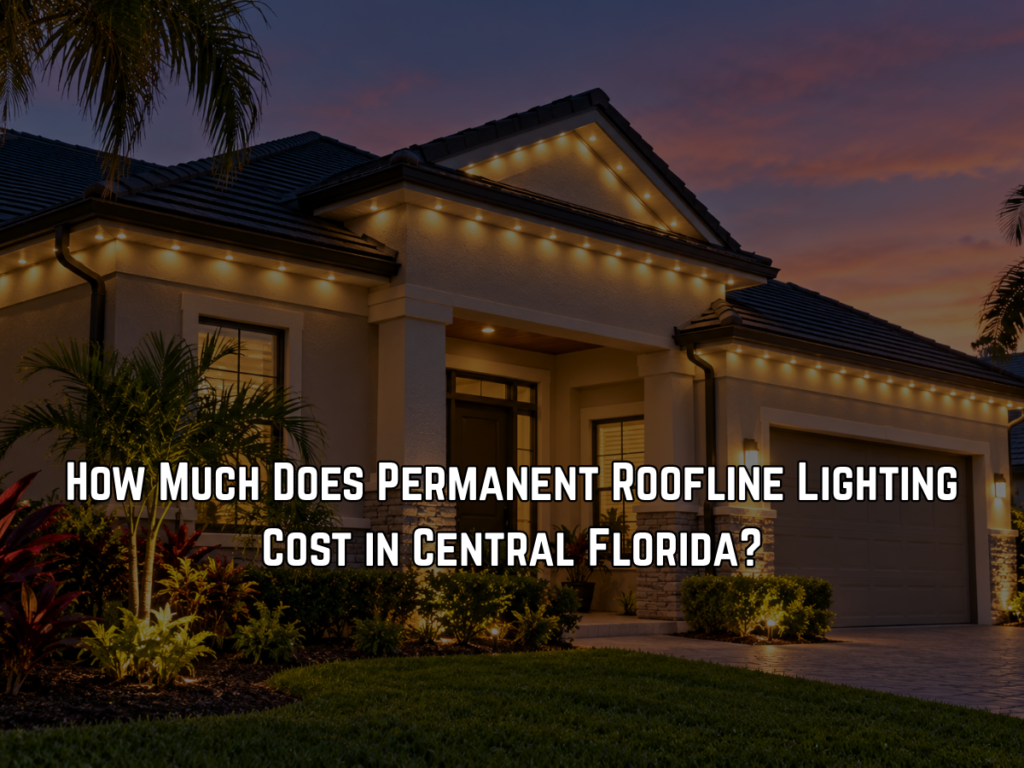
Permanent roofline lighting is priced by the foot. Almost every quote comes down to three things: how much roofline you light, how hard that roofline is to work on, and which system goes into the track. Here’s what each one costs, with the sources behind the numbers.
Quick Answer: Permanent roofline lighting typically costs $20 to $40 per linear foot installed, according to HomeGuide. That puts a 100-foot single-story front at about $2,000 to $4,000 and a 200-foot roofline at $4,000 to $8,000. Manufacturer pricing from Trimlight ($18 to $35 per foot) and JellyFish Lighting ($25 to $35 per foot) lands inside that same band. Extra controllers, a new outdoor outlet, and add-on zones like a lanai are where Central Florida quotes usually climb.
Key Takeaways
- Linear footage sets the price, not square footage. Lighting only the street-facing side is the single biggest way to control cost.
- Materials make up roughly $8 to $15 of each foot, per one contractor pricing guide. The rest is labor, design, programming, and warranty.
- Corners and peaks cost more than straight runs. A complicated 180-foot roofline can take twice as long to install as a simple one.
- Running costs are small. A 200-foot system draws about 120 to 400 watts at full brightness, roughly $3 to $11 a month at 15 cents per kWh and 6 hours a night.
- DIY kits start near $3 per foot, but they skip the color-matched track, hidden wiring, and labor warranty.
What Permanent Roofline Lighting Costs by Home Size
HomeGuide’s figures put installed permanent lighting at $20 to $40 per linear foot. Applied to a few home types you’ll find all over Central Florida, it looks like this:
| Example home | Lit roofline (example) | Installed cost at $20 to $40 per foot |
|---|---|---|
| Single-story, front elevation only | 100 ft | $2,000 to $4,000 |
| Two-story, front with two gables | 150 ft | $3,000 to $6,000 |
| Two-story, front plus both sides | 200 ft | $4,000 to $8,000 |
| Large hip-roof home, full perimeter | 300 ft | $6,000 to $12,000 |
The footage column is an example, not a measurement of a real house. Your number comes from measuring the eaves and gable edges you actually want lit.
For a second reference point, JellyFish Lighting says most of its homeowners spend $3,000 to $6,000 to light the street-facing sides, with an average around $4,600. That tracks with the table. Most people don’t wrap the whole house.
Want a rough number tonight? Pace off the gutter line across the front of the house, then add the sloped edges of each gable. If you’d also want the back lit for evenings by the pool, measure it separately so it can be priced as its own line.
Why Permanent Lighting Prices Online Don’t Agree
Search this topic and you’ll find per-foot numbers anywhere from $3 to $60. They aren’t all wrong. They’re measuring different things.
| Source | Per-foot price | What the number reflects |
|---|---|---|
| Govee DIY lights | $2.99 to $5.30 | Lights only, you install |
| HomeGuide DIY kits | $8 to $20 | DIY kits, you install |
| Trimlight | $18 to $35 | Installed by a dealer |
| HomeGuide installed | $20 to $40 | Installed, national average |
| JellyFish Lighting | $25 to $35 | Installed |
| ChristmasLightsHQ contractor guide | $30 to $60 | What installers are coached to charge |
The installed prices cluster between about $20 and $35 per foot. The outliers sit at each end: DIY products on one side, and on the other, a pricing guide written for installers that reserves $50 to $60 per foot for premium markets and complicated rooflines.
What You’re Actually Paying For in Each Foot
The same ChristmasLightsHQ guide lists what installers pay for materials:
| Component | Installer’s material cost |
|---|---|
| Aluminum track | $2.50 to $4.50 per foot |
| LED nodes | $2 to $7 each |
| App-connected controller | $350 to $500 per job |
| Connectors, wire, end caps, hardware | $1 to $2 per foot |
By that guide’s math, most installers spend $8 to $15 per foot on materials. So on a $25-per-foot quote, the larger share pays for ladder time, design, app programming, and a warranty the installer carries for years.
That’s the honest reason a $3-per-foot kit and a $25-per-foot install can both be fair prices. They’re different products.
What Raises or Lowers the Price on a Central Florida Home
Front only, or the whole house
This is the biggest lever. Lighting the street-facing elevation and leaving the sides and back dark can cut your footage in half. Plenty of homeowners start with the front and add the rear later, though Trimlight notes that bundling zones into the first install usually costs less than two separate visits.
Corners, peaks, and second stories
Straight runs go up fast. Every corner needs cutting and fitting; every peak means moving the ladder again at a steeper angle. The ChristmasLightsHQ guide estimates a simple 180-foot roofline takes a two-person crew 4 to 5 hours, while the same 180 feet with 15 corners and several peaks can take 8 to 10. Some installers add $15 to $30 per corner or peak. Others just raise the per-foot rate.
Hip roofs
Hip roofs are a common sight across Central Florida. The Florida Department of Financial Services describes the hip shape as the most wind-resistant roof and one that qualifies for a wind mitigation discount. For lighting, a hip roof gives you one continuous eave around the house with no gable peaks to outline. That’s clean, efficient footage. It also means a full-perimeter install adds up quickly, because every side has an eave worth lighting.
Your fascia, not your tile
This one surprises people. With seasonal Christmas lights, a concrete tile roof slows the crew down. Permanent track mounts to the fascia board below the roof edge, so the tile itself rarely changes the price. The fascia does. Soft or rotted wood fascia, which years of Florida humidity can cause, should be repaired before track goes on it. Homes with stucco eaves or flat parapet walls may need a different mounting approach, and a site visit will catch that before it becomes a surprise.
Node type and spacing
RGB-only nodes blend red, green, and blue to fake white, and it often comes out slightly blue or pink. RGBW nodes add a dedicated white diode. They cost more, but they’re what make an everyday warm white look right. If warm white will be your nightly setting, our Kelvin temperature guide explains which color temperatures suit a home exterior.
Spacing matters too. Trimlight offers 6, 9, and 12-inch spacing; tighter spacing means more nodes per foot and a higher quote, with a fuller line of light in return.
Controllers and power
One controller doesn’t run unlimited footage. On JellyFish Lighting’s system, a controller covers about 263 feet, and each additional controller costs $650 to $850. A large estate can cross that line.
Power location counts as well. If there’s no outlet where the controller should live, HomeAdvisor puts a new outdoor GFCI outlet at $300 to $1,400, depending on how far the wiring has to run.
Lightning protection
Central Florida gets a lot of lightning, and the controller and power supply are the parts a surge is most likely to take out. Ask where the controller will be mounted and whether it’s protected. A whole-house surge protector at your electrical panel runs $70 to $700, about $300 on average, per HomeAdvisor. It’s usually not part of a lighting quote, but it protects far more than the lights.
Time of year
HomeGuide points out that installers are busiest in fall and early winter and suggests spring, summer, or late winter for better pricing. Here, that also keeps you out of the Christmas rush for crew availability.
Ongoing Costs After the Install
| Cost | What to expect |
|---|---|
| Electricity | About $3 to $11 a month for 200 feet at full brightness |
| LED diodes | Rated 20,000 to 50,000 hours, about 10 to 20+ years of use (HomeGuide) |
| Controller and power supply | The parts most likely to need replacing first, especially after a surge |
| Service visits | Depends on the warranty; labor coverage is often shorter than parts coverage |
The electricity math. Trimlight says a 200-foot house uses 120 to 400 watts, depending on how many bulbs it has. At 6 hours a night, that’s 21.6 to 72 kWh a month. At 15 cents per kWh, you’re looking at $3.24 to $10.80 a month. That’s the ceiling at full brightness. A warm white scene at partial brightness draws less. Swap in the rate from your own Duke Energy, OUC, or FPL bill for an exact figure.
Warranties vary a lot. Trimlight backs its parts for life, while labor is covered by each dealer for a minimum of one year. Many DIY kits carry one to two years. Read what’s excluded, especially storm and lightning damage, and who handles service if something fails in year four.
DIY Permanent Lights vs. Professional Installation
Govee lists its DIY permanent lights at $2.99 to $5.30 per foot, or about $299 to $860 for 100 to 200 feet. HomeGuide puts DIY permanent kits at $8 to $20 per foot, or $800 to $4,000.
What the low number leaves out:
- Ladder work along second-story eaves
- Cutting and joining runs at every corner
- Routing wire so nothing shows from the street
- An outdoor outlet in the right spot
- A track painted to match your fascia, since many budget kits clip or stick on instead
My take: on a single-story house with a straight eave and an outlet already in the garage, a quality DIY kit is a reasonable weekend project. On a two-story home with multiple gables, I’d rather see a trained crew on that ladder than you.
Is It Worth the Money? A Cost-Per-Year View
Spread over 10 years, the low end of HomeGuide’s LED lifespan estimate, a $4,000 system works out to $400 a year before any repairs. Compare that to full-service seasonal lights, which run about $1,000 to $2,400 every year for a 200-foot roofline, as covered in our Christmas light installation cost guide.
Two caveats keep that comparison honest. A permanent system only replaces the roofline part of your holiday bill, so wrapped oaks, palms, and wreaths still need a seasonal crew through our Christmas light installation service. And the roofline lights the house the other eleven months, which no seasonal display does. For the full break-even math, storm considerations, and HOA rules, read permanent vs. seasonal Christmas lights for Florida homes.
How to Read a Permanent Lighting Quote
A good quote answers these on paper:
- How many linear feet, broken out by elevation (front, sides, rear)?
- RGB or RGBW nodes, and at what spacing?
- Is the track painted or color-matched to your fascia?
- How many controllers and power supplies, and where will they be mounted?
- Is any electrical work included, such as a new outdoor outlet?
- What does the warranty cover for parts and for labor, and for how long? Are storm or lightning damage excluded?
- Does the price include app setup, scheduling, and a walkthrough before the crew leaves?
A single lump-sum number with no footage and no system details is a red flag. You can’t compare it to anything.
FAQs
Does a two-story home cost more?
Usually. More height means more ladder time and safety work, and second stories often add gables and peaks. Some installers charge a higher per-foot rate for it; others build it into one flat rate. Ask before you compare quotes.
Will permanent roofline lights raise my electric bill much?
No. A 200-foot system tops out around $3 to $11 a month at full brightness, using Trimlight’s wattage figures and a 15-cent rate. Most everyday scenes run dimmer than that.
Can I start with the front and add the back later?
Yes. Most systems can be extended with more track and, if needed, another power supply. Doing it all at once is usually cheaper, since it saves a second trip and setup.
Is there a cheaper time of year to install?
HomeGuide suggests spring, summer, or late winter, when installers aren’t in their busy season. Nothing comes down in January, so an off-season install loses you nothing.
Do I need HOA approval for permanent lights?
In most Florida HOAs, yes. A permanent system is usually treated as an exterior change, so plan time for the architectural review before booking an install date.
Can the same lights do more than Christmas?
That’s the point of them. Warm white most nights, team colors on game day, red, white, and blue in July. If you like the idea of color across the whole property, not just the roof, take a look at color-changing lighting.
Getting a Real Number for Your Home
Published ranges get you in the right neighborhood. Your actual price depends on your footage, your fascia, and how you’d use the lights after December.
Sloan Lighting Solutions installs permanent roofline lighting across Central Florida, from Lake Mary and Heathrow to Winter Park and Windermere. We measure every elevation, match the track to your trim, and bring our demo trailer to the consultation so you can see the light at night before you decide anything. Request a consultation and we’ll put an itemized number in front of you.
Pricing reflects 2026 published data from HomeGuide, HomeAdvisor, and the manufacturers listed. Every home is different, so treat these as planning ranges, not a quote.